
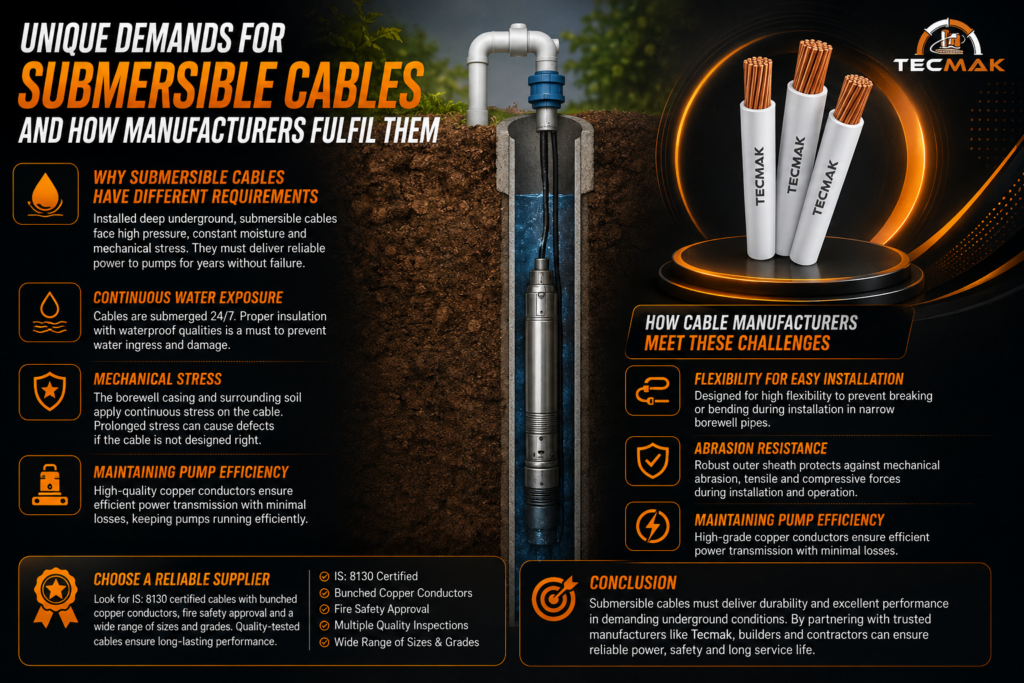
Submersible cables are faced with tough conditions. As we go deeper into the underground, the pressure grows. Moisture and other environmental factors also become critical. An ordinary house wire will never survive in these conditions. Leave surviving, they would wear during the installation itself. The wires and cables manufacturers consider these challenging factors to design appropriate cables that don’t wear out or break down.
Why Submersible Cables Have Different Requirements
As the submersible cables are installed within the ground, they are expected to perform without failure for decades. Whether it is a single-storey house or a multi-storey apartment, it should transmit enough current to the pumps to draw water.
Continuous Water Exposure
The cables are buried along with the delivery pipes and connected to the pumps, where they are submerged constantly. Water exposure can damage the insulation layer of other cables. Proper insulation with waterproof qualities is a must.
Mechanical Stress
During installation, the borewell casing applies continuous stress on the cable. Though the experienced plumbers ensure minimal stress, the prolonged influence can develop defects in the cable.
How Cable Manufacturers Meet These Challenges
The wires and cables manufacturers produce cables that are perfectly suited for the submersible conditions. Here is how they meet these challenges:
Flexibility for Easy Installation
Many cables fail due to breaking due to bending and stress within the borewell pipe. Flexible cable design allows the plumbers to bury the whole setup without worrying about the cable tearing or bending. The manufacturers balance the flexibility with mechanical strength.
Abrasion Resistance
The abrasive forces are high in the submerged conditions. Cables are subjected to mechanical forces as they are buried in the underground. The manufacturer designs these cables to give enough strength to bear the tensile and compressive forces. A robust outer sheath protects the cable from physical damage during installation and daily operation.
Maintaining Pump Efficiency
Not to forget that the core function of the cable is to transmit power to the pump. High-quality copper conductors are featured in these cables so that they can supply power without considerable losses during transmission.
Choose a Reliable Supplier
When you are selecting the wires and cables manufacturers for your submersible installation, choose a supplier that provides quality-tested cables. The IS: 8130 is the Indian standard for submersible cables. Bunched copper conductors, fire safety approval, and a variety of grades and sizes are the markers of an experienced manufacturer. Their cables undergo multiple inspections before reaching the market.
Conclusion
The submersible cables need to be designed for durability and excellent performance in the underground conditions where mechanical abrasion and moisture are much higher than above ground. By selecting reliable wires and cables manufacturers like Tecmak, the builders and contractors can be assured of quality and performance. Their variety of cables has a balanced configuration of sizes and current-carrying capacity.