
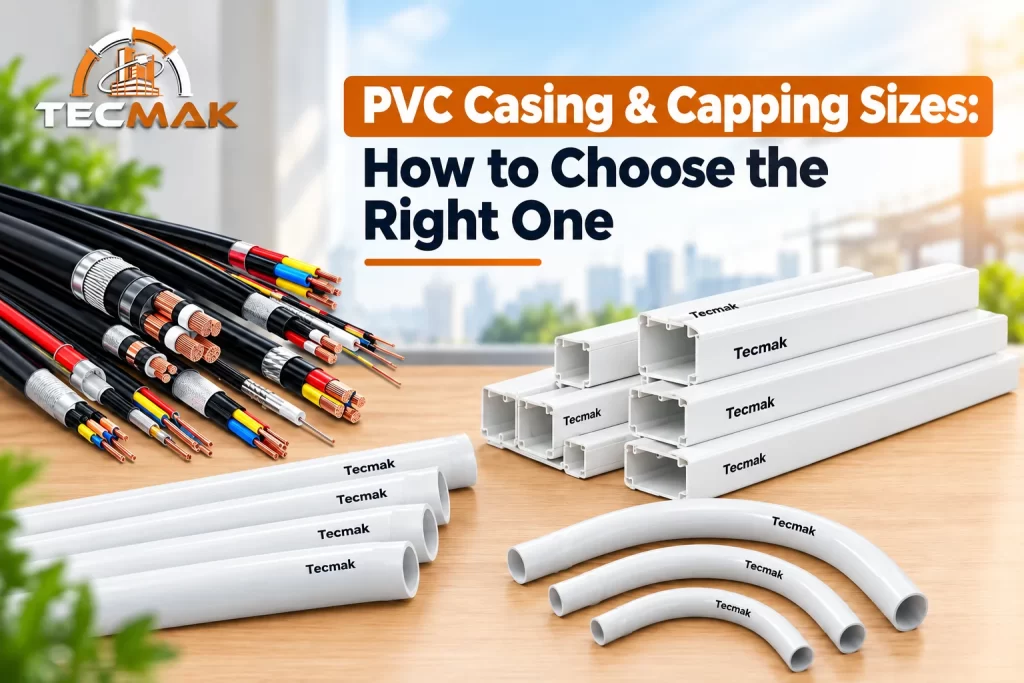
Electrical wiring requires an enclosure for it to remain organized and safe. PVC casing and capping offer a way to manage wiring fixed to surfaces without compromising the installation. Enclosure dimensions may vary since wiring needs may involve only a few cables in residential settings or many different cables in commercial installations. Casing and capping come in different dimensions, which determine the number of wires that can fit into the enclosure. PVC casing and capping manufacturers offer several sizes suitable for various wiring requirements and installation conditions.
What are PVC Casing and Capping
PVC casing refers to a rectangular duct that is used to arrange and cover wires installed on flat surfaces. The capping is used to cover the casing and thus protect the internal wiring. Both the casing and the capping work together to provide good surface wiring. The casing is made from PVC, which gives the system the required lightness and durability.
Why PVC Casing & Capping Comes in Different Sizes
A universal casing cannot cater to all variations of wiring design. Applications may vary in terms of the number of casings and their sizes.
Compact Sizes for Simple Wiring
Smaller cases are useful for installations where wiring is small. These small cases allow laying of wires inside the case without wasting valuable wall space. These sizes can fit areas where neat wiring is a must.
Larger Sizes for Multiple Cables
Bigger casing sizes come with extra inside space for installations with numerous wires or cables. They are fit to be used in applications where multiple electrical connections need to be placed in a common wiring path.
Factors That Determine Casing Size
Number of Cables
The number of wires involved in the installation determines the casing size. Different casing sizes suitable for single and multiple cables are thus available.
Cable Size
The size and the nature of the cables also make the casing more or less suitable. Sufficient internal space is required to keep the cables tight in place.
Available Installation Space
The wall dimensions and installation points influence the casing size too. In places where the available space is limited, compact profiles can be used.
Conclusion
The choice of size for casing and capping is determined by the number of cables to be used, cable size, space available for installation, and requirements for usage. The appropriate size ensures that there’s enough space for wires and neat installation. The PVC Casing & Capping manufacturers can provide solutions for all residential, commercial, and industrial wiring needs.
Tecmak provides quality-certified PVC casing and capping for safe cabling across electrical systems.
FAQs
PVC casing and capping work as a covering for power cables, communication and control cables in residential and commercial spaces.
PVC casing can be used in commercial wiring. However, it may need a larger size as commercial spaces have many number of wires to be routed.
A capping covers the open channel of the casing to enclose the cable. It can be removed when access to the cable is required.
The number of cables and their size are the key factors to determine the size of capping and casing.
PVC casing and capping have a durable lifespan because they have good corrosion resistance and impact resistance.